
A Four-Level PPFD Trial on Butterwort (Pinguicula)
Abstract
We grew a butterwort (Pinguicula) across four light levels: 82, 133, 267, and 533 PPFD for 23 days while holding spectrum constant. The brightest setting produced the best plant: at 533 PPFD, the rosette spread widest (+1.5 cm) while plant height decreased (-0.5 cm), indicating a tight, compact rosette. At the lowest level, the plant added height instead of spreading, an early sign of stretching. We conclude that sun-loving carnivorous plants require high light, approximately 300–550+ PPFD (DLI 13–23), to grow compact and well-colored.
1. Introduction
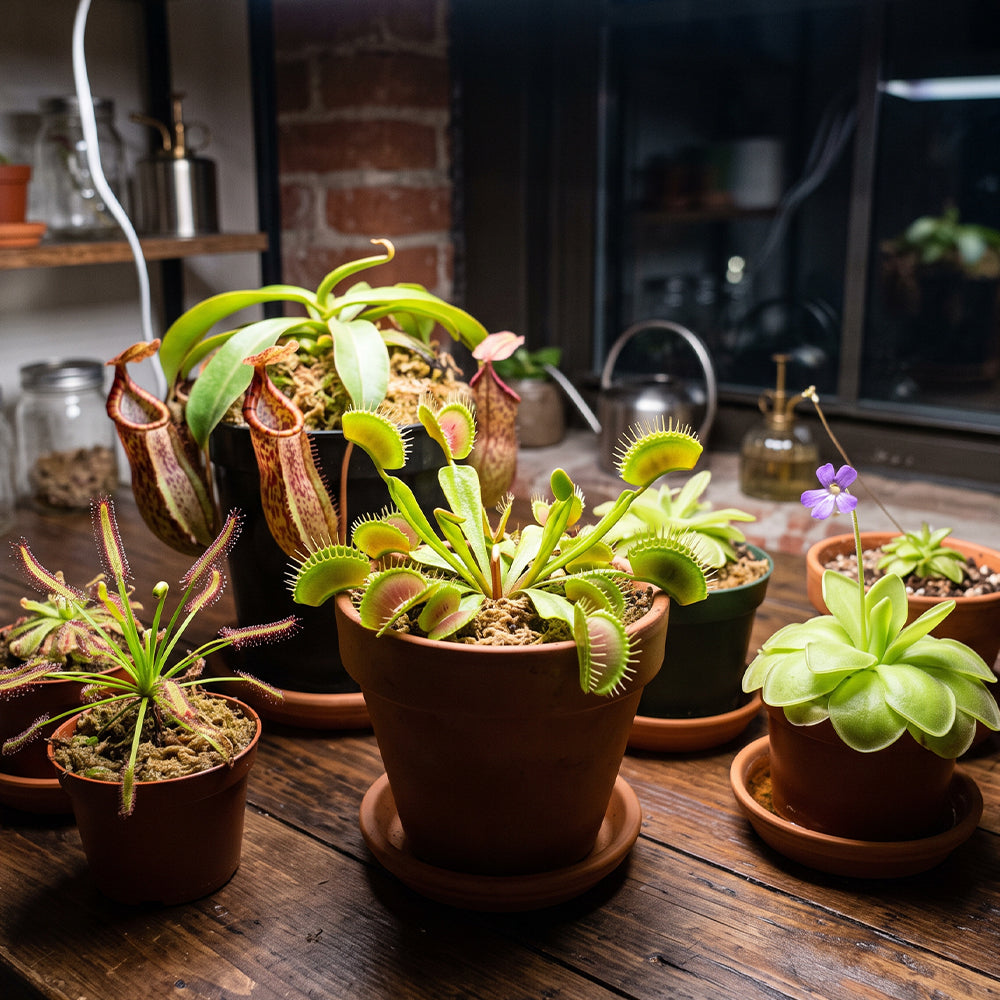
Most popular carnivorous plants—Venus flytraps, sundews, pitcher plants, and most butterworts—grow in open, sunny bogs and rock faces rather than beneath a forest canopy. For these species, adequate light is rarely excessive; insufficient light produces a loose, stretched rosette, paler rather than vivid coloration, and weaker traps. This trial quantifies the response of a butterwort to a wide range of light intensities. Tropical Nepenthes pitcher plants are a notable exception and generally prefer lower, indirect light.
Key quantities. PPFD (µmol/m²/s) is the rate of usable photons reaching the plant. DLI (mol/m²/day) is the daily total, where \( \mathrm{DLI} = \mathrm{PPFD} \times \mathrm{photoperiod\ (h)} \times 0.0036 \). For a rosette plant, rising width alongside falling height indicates a tighter, healthier rosette.
2. Materials and Methods
A single full-spectrum recipe was held constant while intensity was stepped across four levels: 82, 133, 267, and 533 PPFD. The trial ran for 23 days (22 April–7 May 2026) in a shared grow room under controlled watering at 24–26°C. Rosette width and plant height were recorded and averaged across replicates.
3. Results
| Setting | PPFD | Lux | DLI | Rosette Width Gain | Height Change |
|---|---|---|---|---|---|
| Low | 82 | 5,015 | 3.5 | +1.23 cm | +0.94 cm |
| Medium-low | 133 | 8,091 | 5.7 | +0.86 cm | -0.74 cm |
| Medium-high | 267 | 16,173 | 11.5 | +1.06 cm | +0.56 cm |
| High | 533 | 32,207 | 23.0 | +1.50 cm | -0.53 cm |
Table 1. Net growth over 23 days by light level (spectrum held constant). Rising width with falling height indicates a tighter rosette. DLI estimated at a 12-hour photoperiod.

The brightest light produced the best plant. At 533 PPFD, the rosette spread widest (+1.5 cm) while its height decreased (-0.5 cm), meaning the plant grew low and full—the compact rosette carnivorous plant growers seek. At the lowest level (82 PPFD), the plant added the most height (+0.9 cm) while spreading less, an early sign of the stretching commonly seen in under-lit specimens.
Beyond size, strong light is also what triggers the red and pink pigmentation these plants are valued for. In most cases, intensity rather than an unusual spectrum drives that response.
4. Discussion and Recommendations
Sun-loving carnivores require high light, approximately 300–550+ PPFD (DLI 13–23). Few indoor windowsills provide this, especially through winter, so a high-output full-spectrum fixture mounted close to the plant is generally necessary, with attention paid to heat.
The plant itself is the best indicator. A tight, low, often reddish rosette signals adequate light, whereas a tall, pale, loose form points to insufficient light. A grow light on a consistent photoperiod—commonly 12–14 hours—can fully replace a sunny windowsill for many species. Temperate carnivores such as flytraps, sundews, and Sarracenia, as well as Mexican butterworts, favor high light. Tropical Nepenthes are the exception and usually prefer bright indirect light at lower PPFD.
| Plant | Target PPFD | DLI | Notes |
|---|---|---|---|
| Butterwort (Pinguicula) | 300–550+ | 13–23 | Tight, colorful rosette in high light. |
| Sundew (Drosera) | 250–500 | 11–22 | High light supports dew production and red coloration. |
| Venus Flytrap | 300–600 | 13–26 | Full-sun lover; stronger light reddens the traps. |
| Pitcher Plant (Sarracenia) | 400–700+ | 17–30 | The brightest of all; near outdoor levels. |
| Tropical Pitcher (Nepenthes) | 150–300 | 6–13 | The exception; prefers bright indirect light at lower PPFD. |
Table 2. Suggested light levels for carnivorous plants. The butterwort row is supported by this trial; the others combine the same logic with established carnivorous plant guidance.
Suitable Barrina Fixtures
For carnivorous plants, the lensed Barrina Orbgrow series is the natural lead option.
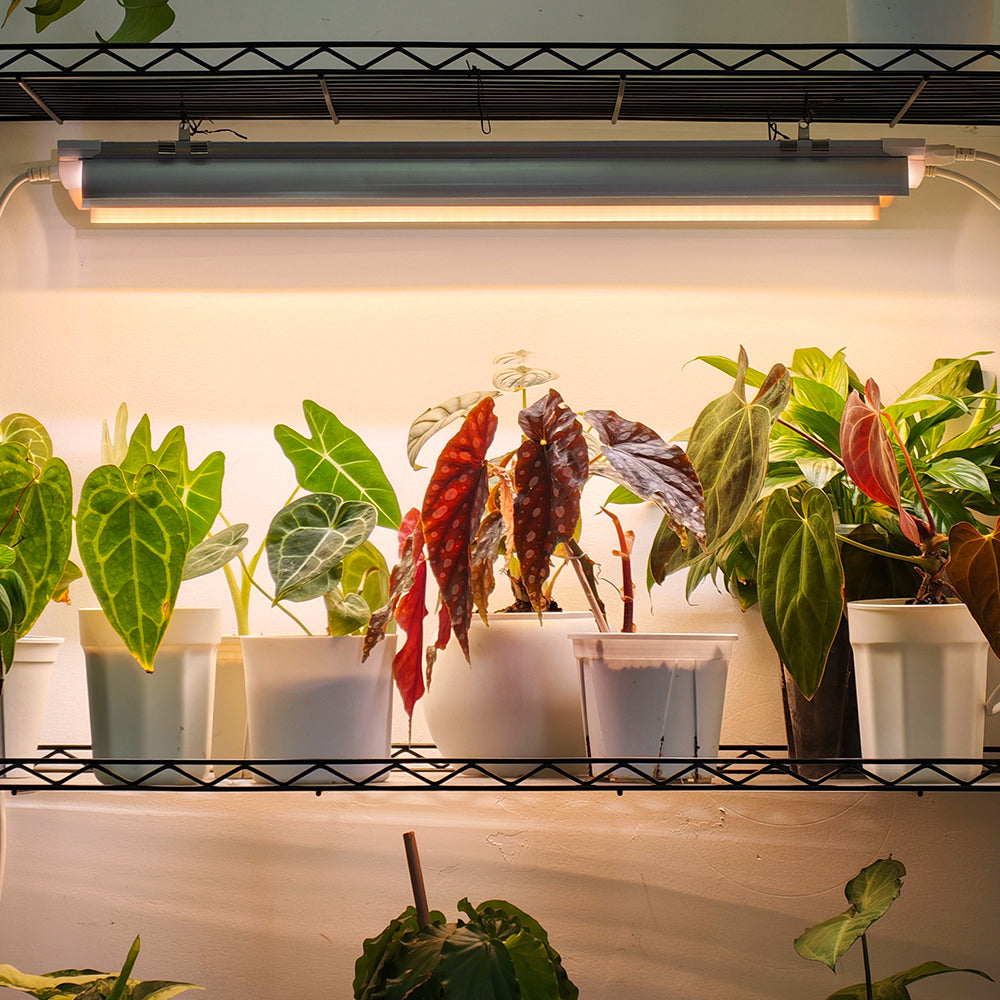
The Barrina Orbgrow Series includes lensed point-source fixtures that concentrate high PPFD where a sun-loving plant needs it most. A 9W Puck can be daisy-chained across a tray, while the Clip version scales up to 44W across four heads for a terrarium setup, with a timer and stepless dimming.
The Barrina T5 Grow Light, a linkable full-spectrum tube fixture, complements this setup by evenly lighting a whole bog tray or windowsill.
All Barrina grow lights are full-spectrum, ETL/FCC-listed, and backed by a 3-year warranty.
5. Frequently Asked Questions
How much light do carnivorous plants need?
Most popular carnivorous plants are sun lovers and require high light, roughly 300–550+ PPFD (DLI 13–23 at a 12-hour photoperiod). In this trial, a butterwort developed its tightest, most compact rosette at the brightest setting, 533 PPFD. Few indoor windowsills supply this consistently, so a high-output fixture is usually needed. Tropical Nepenthes are an exception and generally prefer less.
Can carnivorous plants grow under LED grow lights instead of sunlight?
Yes, provided the light is strong enough. A full-spectrum LED delivering roughly 300–550+ PPFD at the plant can replace a sunny windowsill for most carnivorous species, with the added advantage of a consistent timer-controlled photoperiod.
Why is my carnivorous plant stretching, pale, or not coloring up?
Almost always because of insufficient light. In this trial, low light at 82 PPFD caused the plant to grow taller and looser rather than fill out. Increasing PPFD or moving the light closer typically tightens the rosette and improves coloration.
What spectrum is best for carnivorous plants?
A high-output full-spectrum (white) light is the best general choice. Carnivorous plants usually respond more to intensity (PPFD) than to unusual color recipes; a strong full-spectrum fixture both fuels growth and brings out red coloration.
How close should a grow light be to carnivorous plants?
As close as possible without overheating the plant. Because these species often require high PPFD, mount a full-spectrum fixture near the plants and monitor for heat stress. If leaves begin to crisp or bleach, raise the light slightly.
Notes
Growth figures are averages from Barrina internal grow trials conducted from 22 April to 7 May 2026, with spectrum held constant while intensity varied. The trial plant was a butterwort (Pinguicula); carnivorous species differ, and tropical Nepenthes in particular prefer lower light. PPFD and lux were measured at canopy center. DLI was estimated at a 12-hour photoperiod. Plant responses vary with species, environment, and setup. © 2026 Barrina.