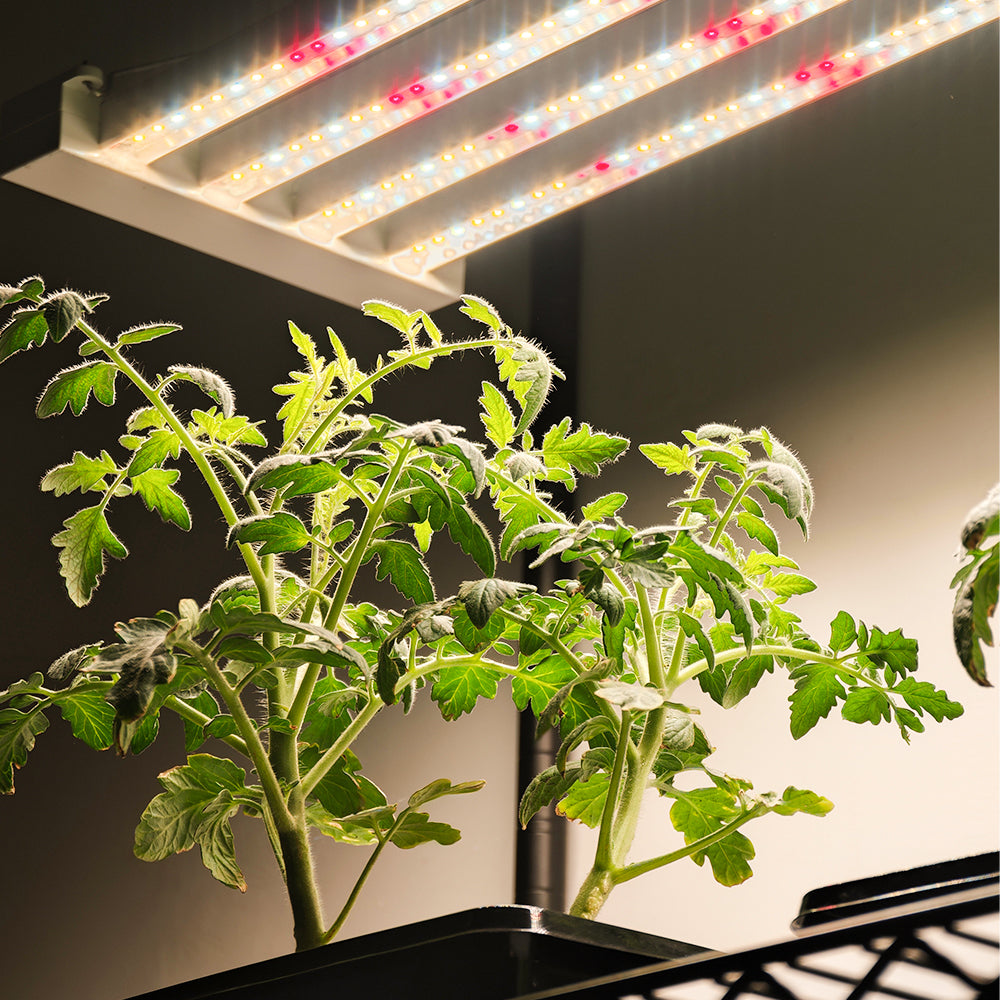

A Five-Spectrum Growth Trial
Abstract
We grew the same dwarf tomato under five grow-light spectra for 23 days (22 April–15 May 2026) and measured canopy width and height. A balanced white spectrum produced the strongest plants: warm white grew the widest canopy (+16.3 cm), while a high-output full-spectrum fixture produced the most compact, sturdy plant, with a height-to-width ratio of 0.36. A red-heavy pink-purple light grew the tallest plant (+8.5 cm) but also produced the worst stretch ratio (0.57), indicating elongation rather than structural growth. For fruiting vegetables, a balanced full-spectrum white light at approximately 200–400 PPFD is recommended.
1. Introduction
Tomatoes are a high-light fruiting crop. To carry fruit well, they require a thick stem and a wide, well-lit canopy rather than height alone. Light spectrum—the relative mix of wavelengths a fixture emits—strongly influences which of these traits a plant develops. Blue light promotes compact, bushy growth; red light promotes stem elongation and flowering; and a balanced full-spectrum light (visually white) supplies both. This trial compares five commercially available spectra to determine which produces the most suitable plant architecture for tomatoes.
Key quantities. PPFD (photosynthetic photon flux density, µmol/m²/s) is the rate of usable photons reaching the canopy. DLI (daily light integral, mol/m²/day) is the cumulative daily total, where DLI = PPFD × photoperiod (h) × 0.0036. Lux describes brightness as perceived by the human eye and is reported only as a familiar reference.
2. Materials and Methods
The trial was conducted in a single shared grow room under controlled watering at 24–26°C, with daily logging of weather, temperature, humidity, nutrient EC, and pH. Five fixtures were positioned at a fixed height of 30.5 cm (12 in) above the canopy. Center-canopy PPFD and lux were metered for each fixture. Canopy width and plant height were recorded at eight time points over 23 days and averaged across replicate plants. Because the five fixtures differed in both spectrum and intensity, the results describe a real-world fixture comparison rather than a single-variable spectral study.
3. Results
| Spectrum | PPFD | Lux | DLI | Width Gain | Height Gain | Stretch Ratio |
|---|---|---|---|---|---|---|
| Full Spectrum | 263 | 17,237 | 11.4 | +14.8 cm | +5.3 cm | 0.36 |
| Warm White | 216 | 12,902 | 9.3 | +16.3 cm | +6.7 cm | 0.41 |
| Daylight 5000K | 226 | 13,717 | 9.8 | +14.3 cm | +6.2 cm | 0.44 |
| White-Pink | 178 | 7,425 | 7.7 | +12.6 cm | +6.4 cm | 0.50 |
| Pink-Purple | 182 | 4,583 | 7.9 | +15.0 cm | +8.5 cm | 0.57 |
Table 1. Net growth over 23 days by spectrum. Stretch ratio = height gain ÷ width gain; lower values indicate sturdier growth. DLI estimated at a 12-hour photoperiod.

Balanced white light produced the best plants. Warm white grew the widest canopy of all (+16.3 cm), and together with 5000K daylight and the full-spectrum fixture, it produced well-proportioned, sturdy plants. The red-heavy pink-purple fixture grew the tallest plant (+8.5 cm in height) but recorded the highest stretch ratio (0.57), indicating internode elongation rather than structural strength. The high-output full-spectrum fixture produced the most compact plant, with a stretch ratio of 0.36: short internodes, a thick stem, and a wide base—the architecture best suited to carrying fruit.
4. Discussion and Recommendations
For tomatoes and other fruiting vegetables, a balanced full-spectrum or warm-white light at approximately 200–400 PPFD is recommended. In this trial, a redder spectrum did not accelerate useful growth; it primarily increased elongation. A bright windowsill commonly provides only 100–200 PPFD, below this requirement, so a dedicated full-spectrum fixture is generally necessary.
Fixtures should be positioned around 30 cm above the canopy and adjusted by observation: stretching indicates insufficient light or excessive distance, whereas bleaching or leaf curl indicates excessive intensity. As plants approach flowering and fruiting, intensity may be raised toward the upper end of the range.
| Crop | Spectrum | Target PPFD | DLI | Distance |
|---|---|---|---|---|
| Tomato | Balanced white / full spectrum | 200–400 | 9–17 | ~30 cm (12 in) |
| Pepper & Chilli | Balanced white / full spectrum | 250–450 | 11–19 | ~30 cm |
| Strawberry | Full spectrum | 200–350 | 9–15 | 25–35 cm |
| Tomato Seedlings | Full spectrum, blue-leaning | 150–250 | 6–11 | 15–25 cm |
Table 2. Suggested starting settings for fruiting vegetables. The tomato row is supported by this trial; the others combine the same logic with established horticultural ranges.
Suitable Barrina Fixtures
Two Barrina grow-light families align well with these findings.
The Barrina T5 Grow Light is a linkable full-spectrum tube fixture (1–4 ft, 5–20W) available in 5000K, warm white, and other tints. Multiple units can be daisy-chained from a single outlet, making it suitable for a shelf, tent, or seed tray of plants.
The Barrina Orbgrow Series includes lensed point-source fixtures such as a 9W Puck, 11W Bulb, 22–44W Clip, and a 3W rechargeable unit. With timer and dimming control, it is suitable for a single specimen plant or for concentrating high PPFD on one plant.
All Barrina grow lights are full-spectrum, ETL/FCC-listed, and backed by a 3-year warranty.
5. Frequently Asked Questions
What is the best grow light spectrum for tomatoes?
A balanced white or full-spectrum light. In this trial, warm white grew the widest canopy, while the full-spectrum and 5000K daylight fixtures produced the sturdiest, most compact plants. A red-heavy light grew the tallest plant, but mostly by stretching it.
How much PPFD do tomatoes need?
Approximately 200–400 PPFD at the top of the canopy during vegetative growth, rising toward the higher end as plants approach flowering and fruiting. A bright windowsill often falls short of this, so a dedicated full-spectrum light is usually needed.
Why are my tomato seedlings tall and leggy?
Leggy seedlings usually indicate too little light, a fixture mounted too far away, or a spectrum that is too red. Increase PPFD, lower the fixture (we used 30 cm / 12 in), or switch to a balanced full-spectrum light.
How far should a grow light be from tomato plants?
Start at about 30 cm (12 in) above the canopy and adjust from there. If plants stretch toward the light, lower the fixture or raise intensity. If leaves bleach or curl, raise the light.
How many hours of light per day?
Most growers run 14–16 hours per day for tomatoes. A longer photoperiod raises total daily light (DLI) at a given PPFD, but plants still require a dark period.
Notes
Growth figures are averages from Barrina internal grow trials conducted from 22 April to 15 May 2026 in a single shared grow room with controlled watering at 24–26°C. The five fixtures differed in both spectrum and intensity. PPFD and lux were measured at canopy center. DLI was estimated at a 12-hour photoperiod using DLI = PPFD × hours × 0.0036. Plant responses vary with genetics, environment, and setup, and all ranges should be treated as starting points. © 2026 Barrina.