
After three months under four controlled light levels, 12 species sorted themselves into three clear groups. Here's the cheat-sheet for where each one belongs on your shelf.
The experiment: 12 species · 4 intensity levels · ~3 monthsUnits: PPFD (µmol/m²/s)
If you only remember one thing from this whole experiment, make it this map. Plants don't simply want "bright" or "low" light — each wants a specific band of intensity, and missing it shows up fast: too little and they stretch and pale; too much and they scorch and shrink.
I plotted every species at the PPFD level where it grew best. Three zones jumped out:

Each dot marks a species' best-performing light level (PPFD). Colors group them by plant family. The background bands are the three practical light zones.
The three light zones
| Zone | PPFD | Plants | What happens there |
|---|---|---|---|
| High light | 267–533 | Echeveria (both) | Compact, colorful growth; succulents tolerate the strongest light I tested and reward you for it. |
| Mid | 133–267 | Anthurium, staghorn fern, butterwort | Want genuine light, but the top of this band is their ceiling — push higher and they stall. |
| Low light | 82–133 | Caladiums, alocasias | Understory jungle plants; best growth down here, visible damage above 267 PPFD. |
How to use it on a shelf
Rack-layering cheat-sheet
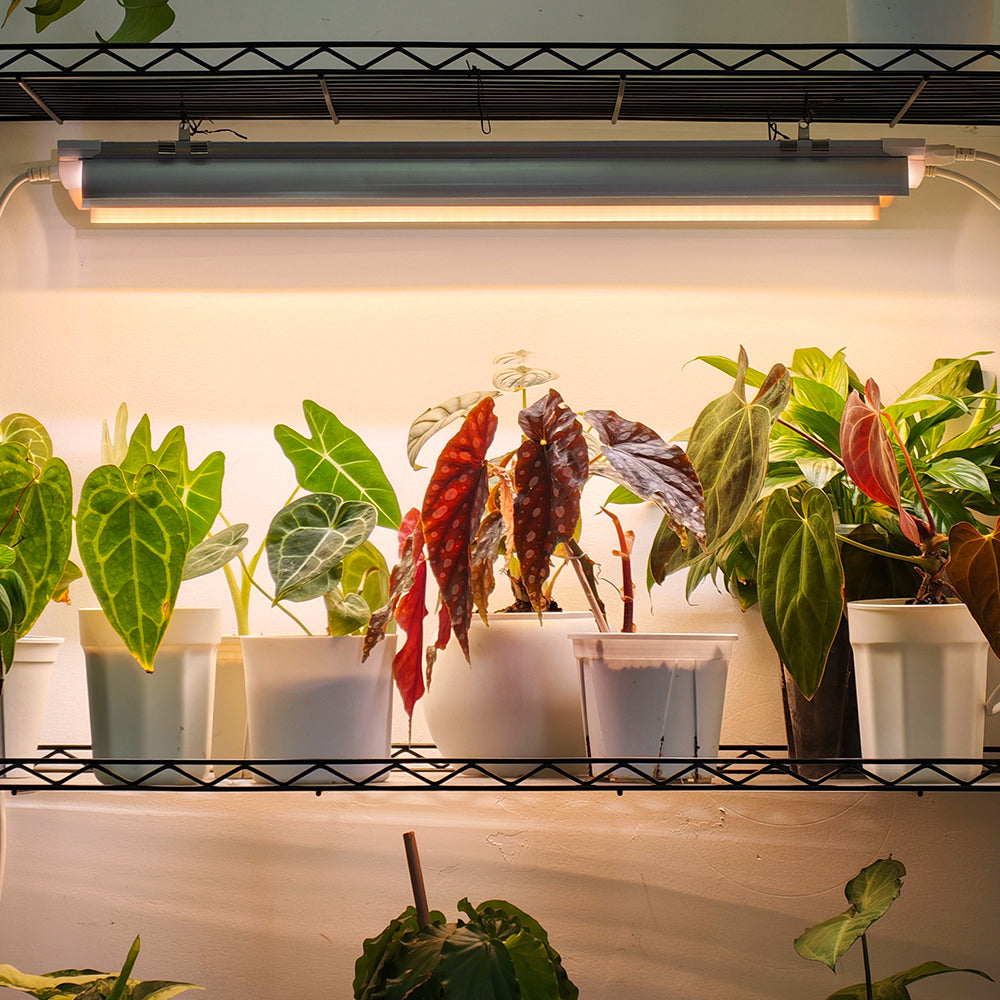
- Top shelf / closest to the light (267–533 PPFD): succulents — Echeveria and friends.
- Middle shelf (133–267 PPFD): anthurium, staghorn fern, butterwort.
- Bottom shelf or shaded edge (82–133 PPFD): caladiums and alocasias — keep them out of the hot zone.
Two plants worth calling out
Anthurium is the generalist. One of the two hybrids grew steadily at every level I tested — if you have an awkward spot, an anthurium will probably take it. The variegated alocasia is the diva: with less chlorophyll to spare, it was the most light-sensitive plant in the trial, punished hardest by strong light.
One caveat. These optima come from a red-heavy, full-spectrum light run on a fixed daily schedule. Change the spectrum, the hours, or the season and the exact numbers shift. But the ranking — succulents high, aroids low — is rooted in where these plants evolved and holds up broadly.