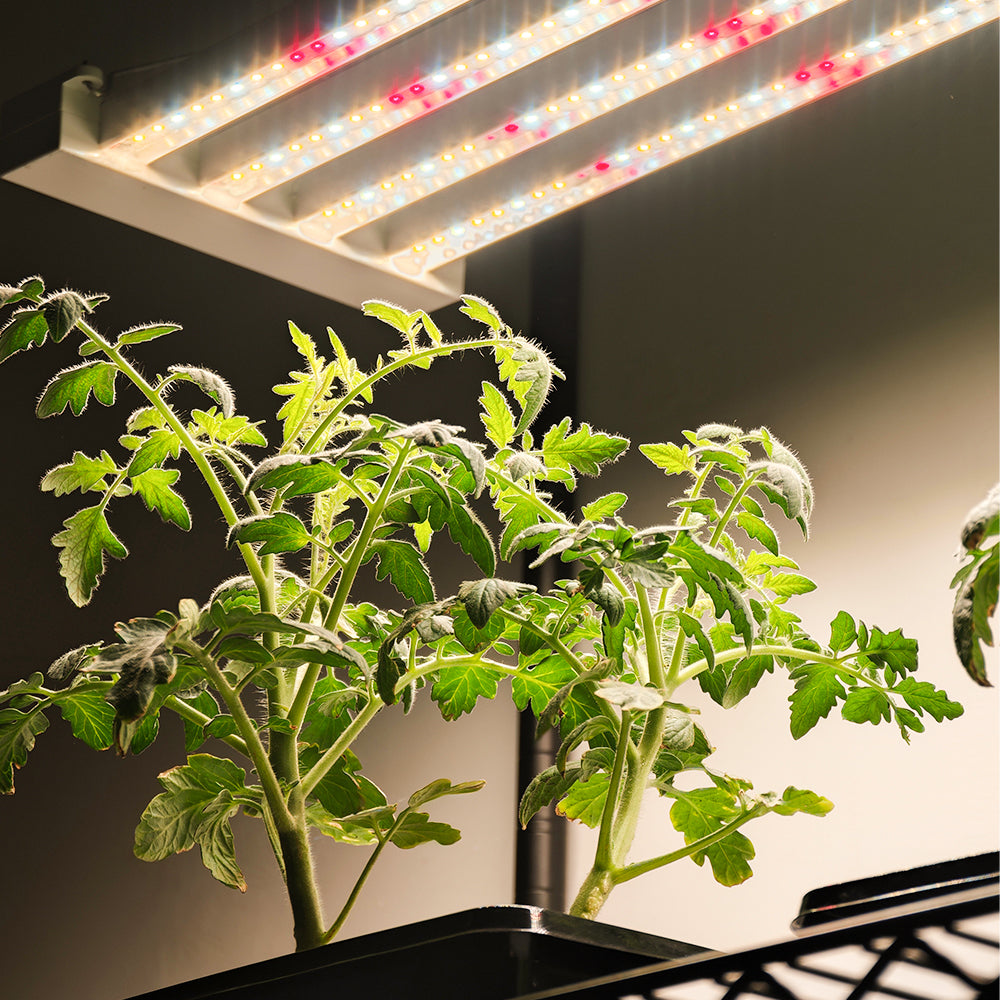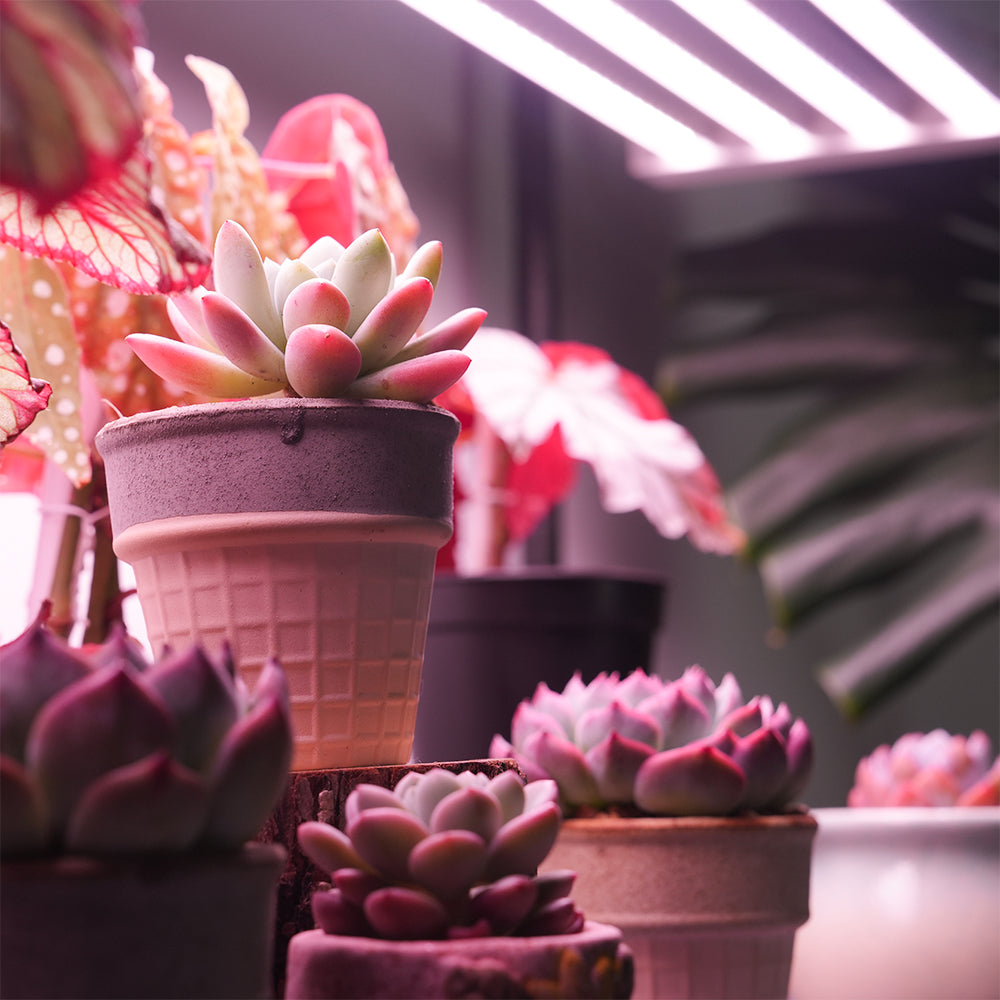

Everyone argues about grow-light spectrum. But the setting that usually decides whether a plant thrives or fries on your shelf is intensity — so I tested it properly, from Echeveria to Caladium to a carnivorous butterwort.
Walk into any houseplant forum and you'll find people debating light color — "full spectrum," "red and blue," "warm vs cool." Spectrum matters. But I've watched far more plants suffer from getting too much or too little light than from the wrong color. Intensity is the dial most of us set by guesswork.
So I ran a controlled test. One light. One spectrum. The only thing I changed was how much light reached the plants — four levels of it — and then I watched 12 very different species respond over about three months.
The plants
I deliberately picked species that "want" different things — sun-loving succulents next to shade-dwelling jungle aroids, plus a fern and a carnivore to stress-test the extremes:
| Plant | Type | Reputation |
|---|---|---|
| Echeveria 'Chihuahua' & 'Amber' | Succulents | Sun lovers |
| Caladium 'Hilo Beauty', 'Scarlet Lady', green form | Fancy-leaf caladiums | Shade / understory |
| Alocasia 'Green Velvet' (+ variegated) | Jewel alocasias | Bright shade |
| Anthurium — two hybrid seedlings | Aroid | Adaptable |
| Curly staghorn fern (Platycerium) | Epiphytic fern | Bright, indirect |
| Butterwort 'Tysje' (Pinguicula) | Carnivore | Bright but sensitive |
| Dwarf red tomato | Edible (spectrum side-trial) | Full sun |
The light
Every plant sat under the same fixture: a warm, full-spectrum "grow-white" LED (roughly 3862 K, with a red-to-blue ratio around 7:1). Here's its measured spectral power distribution — the mix of colors it actually emits:
The fixture is red-heavy: a sharp blue spike (keeps plants compact) and a big red hump (drives photosynthesis and flowering), with continuous white in between. This spectrum stayed constant across the whole experiment.
The variable: intensity, measured in PPFD
Here's the one thing worth learning if you take away nothing else. Your phone's light-meter app reads lux — brightness as the human eye perceives it. Plants don't photosynthesize with your eyes. What they care about is PPFD: the number of usable photons landing on a leaf each second (µmol/m²/s). Two lights can show the same lux yet deliver wildly different PPFD, which is exactly why lux-based advice leads people astray. So every number in this experiment is PPFD.
By raising and lowering the same fixture, I set four intensity levels — from a dim windowsill to a bright greenhouse:
The four PPFD levels used throughout. Same light, same color — only the amount changes.
How I ran it
Each of the four PPFD levels got three plants of each species (so I could average out the odd runt or overachiever). Everything shared the same fixture, the same 90 cm working distance, and the same room. Then, every one to two weeks from late April to mid-July, I measured plant spread, height, leaf count, and leaf size.
Here's what one species looked like at the end — four groups lined up from lowest to highest PPFD. Even in a single frame the effect of intensity is obvious:
Echeveria 'Chihuahua' after ~3 months. Left (low PPFD) stays green and loose; right (high PPFD) turns pink and tight — the stress coloration succulent growers actually chase.
How to read the charts
Every result uses the same chart style: four lines, one per PPFD level, tracked over time. A line climbing = the plant is growing; a line sagging = it's shrinking or stressed. Here's a real one — the butterwort's rosette width — so you know what you're looking at:
Rosette width of Pinguicula 'Tysje' at four PPFD levels. Notice the 133 PPFD line pull away from the pack — that's its sweet spot.
Reading tip: don't just look at who's tallest at the end — watch the direction. The highest light (533) often starts fine, then flattens and dips. The lowest (82) never gets going. The winner is usually somewhere in the middle, and it's different for every plant.