
Both succulents barely changed width in three months — but that's not the story. The real signal is in their height and their color.
The experiment: 12 species · 4 intensity levels · ~3 monthsUnits: PPFD (µmol/m²/s)
If you're expecting dramatic before-and-after size photos, succulents will disappoint you: they're slow, and three months indoors won't bulk up an Echeveria much. The interesting response to light isn't size — it's shape and color. And on both counts, more light won.
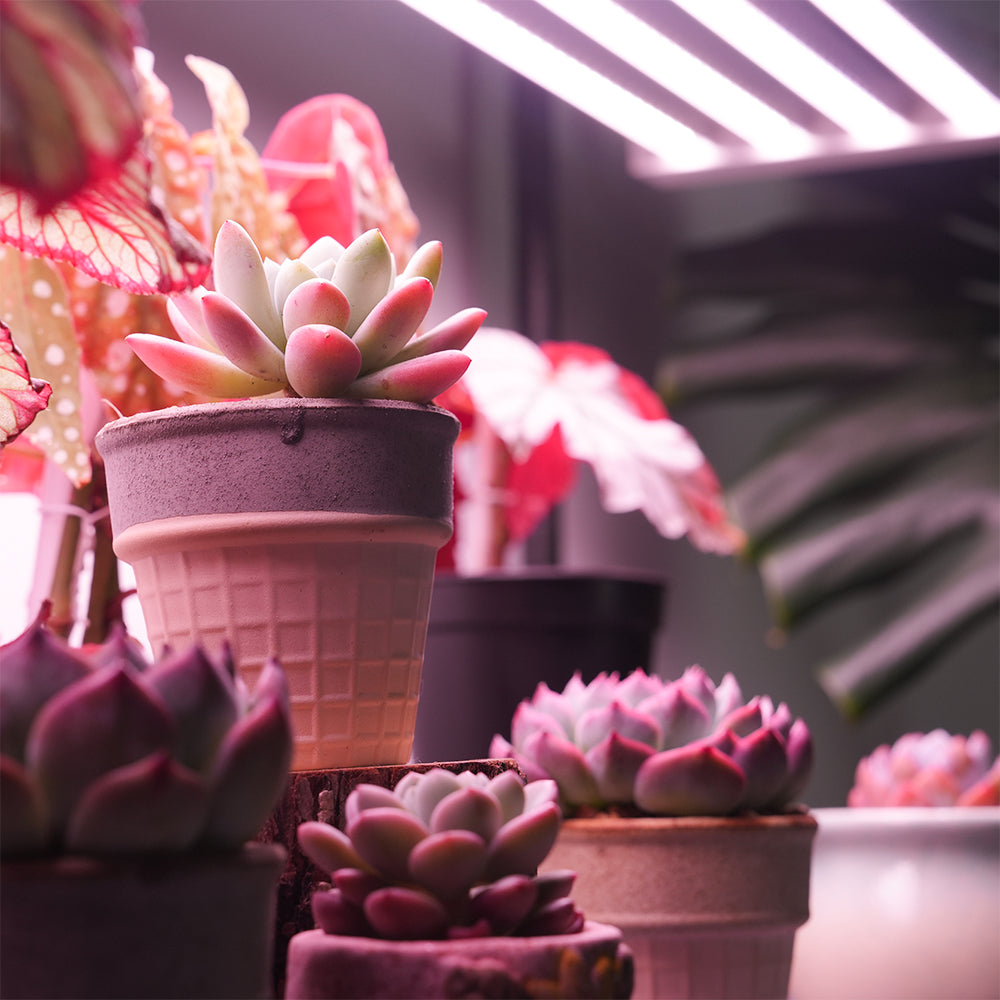
Echeveria 'Chihuahua', four light levels after ~3 months. Left to right: as PPFD rises, the rosettes get tighter and pinker.
Height is a compaction signal (and lower is better)
For a rosette succulent, plant height is really a stretch gauge. When light is too weak, the plant etiolates — the stem lengthens, leaves space out and angle upward as it reaches for more. When light is strong, the opposite happens: the rosette pulls in tight and flat. So a height line that drops under strong light is good news.
'Chihuahua' height over time. The strongest light (533 PPFD) trends down — the rosette tightening — while the plant stays put. That's compaction, not decline.
'Amber' tells the same story: height eases down under stronger light, with the 267 PPFD line among the tightest.
The color payoff
Look again at the lineup photo. From about 267 PPFD up, the leaves flush pink and red — anthocyanin pigments the plant produces as mild sun-stress protection. It's the exact "stressed" coloration succulent growers chase, and it simply doesn't appear under low light, where the same plants stay flat green and loose.
What to actually do
Echeveria, practical settings
- Give them your strongest light — 267–533 PPFD is ideal.
- Don't expect fast growth; expect tight, colorful rosettes that hold their form.
- Low light (82 PPFD) keeps them alive but green, stretched, and shapeless.
Myth check: "succulents burn under indoor LEDs." Not these, not at these levels. Typical household grow-light intensities rarely approach real midday sun — for most indoor succulents the problem is far more often too little light than too much.